


Sports & Fitness
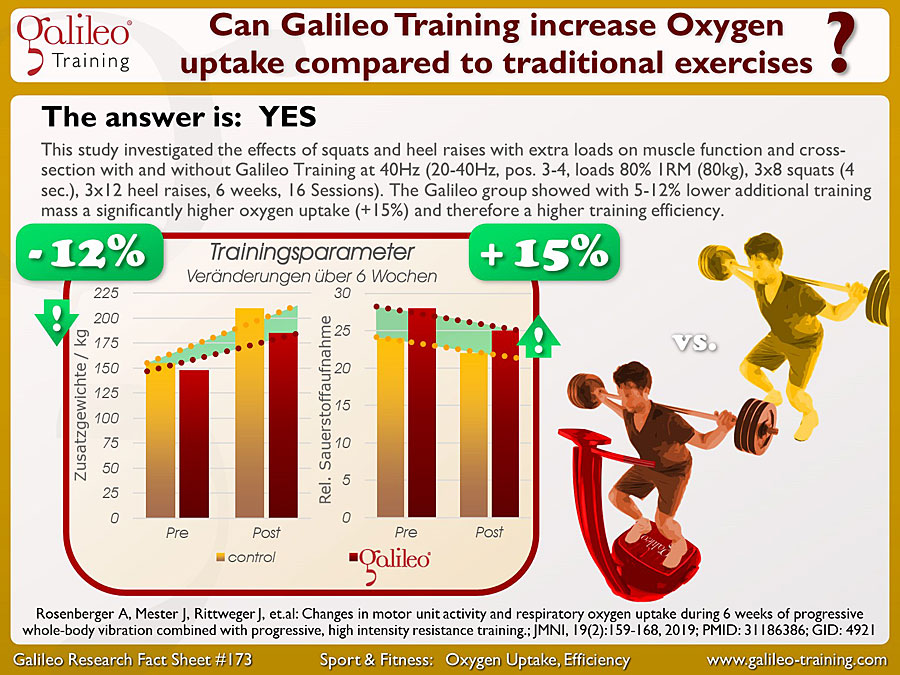
Galileo Research Facts No. 173: Can Galileo Training increase Oxygen uptake compared to traditional exercises?
This study investigated the effects of squats and heel raises with extra loads on muscle function and cross-section with and without Galileo Training at 40Hz (20-40Hz, pos. 3-4, loads 80% 1RM (80kg), 3x8 squats (4 sec.), 3x12 heel raises, 6 weeks, 16 Sessions). The Galileo group showed with 5-12% lower additional training mass a significantly higher oxygen uptake (+15%) and therefore a higher training efficiency...
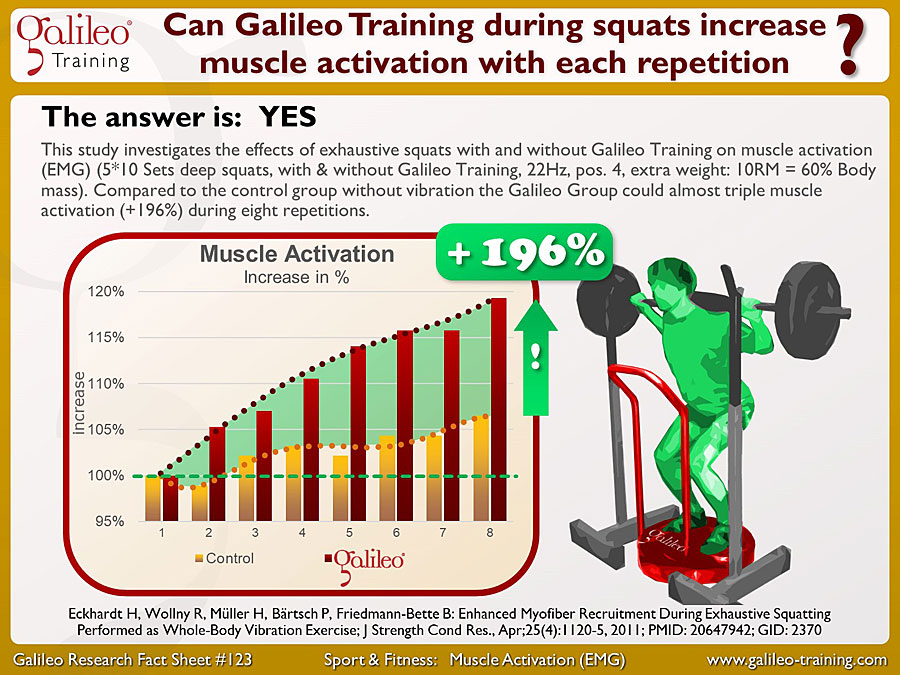
Galileo Research Facts No. 123: Can Galileo Training during squats increase muscle activation with each repetition?
This study investigates the effects of exhaustive squats with and without Galileo Training on muscle activation (EMG) (5*10 Sets deep squats, with & without Galileo Training, 22Hz, pos. 4, extra weight: 10RM = 60% Body mass). Compared to the control group without vibration the Galileo Group could almost triple muscle activation (+196%) during eight repetitions...
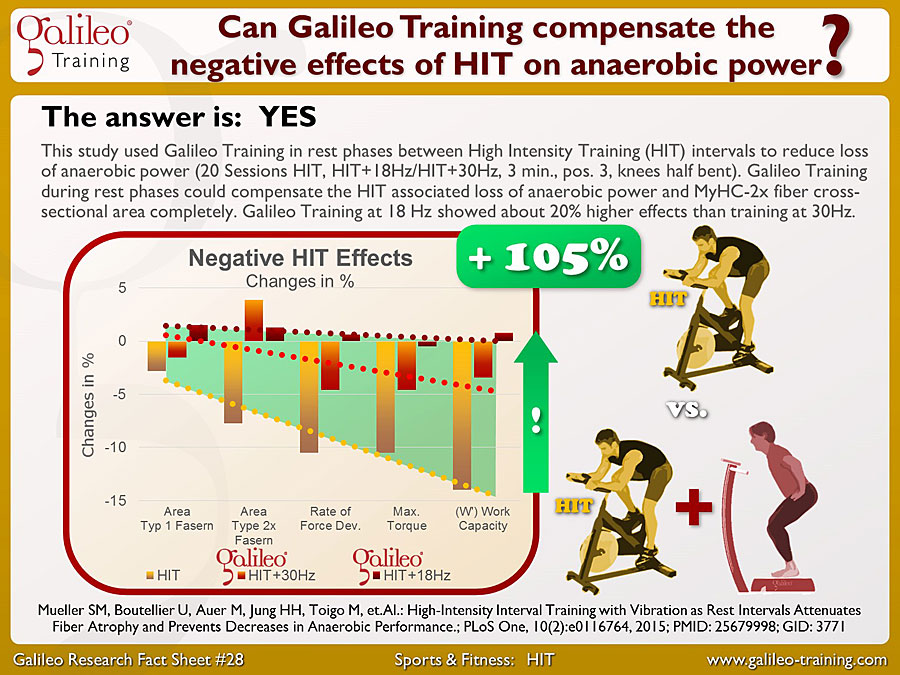
Galileo Research Facts No. 28: Can Galileo Training compensate the negative effects of HIT on anaerobic power?
This study used Galileo Training in rest phases between High Intensity Training (HIT) intervals to reduce loss of anaerobic power (20 Sessions HIT, HIT+18Hz/HIT+30Hz, 3 min., pos. 3, knees half bent). Galileo Training during rest phases could compensate the HIT associated loss of anaerobic power and MyHC-2x fiber cross-sectional area completely. Galileo Training at 18 Hz showed about 20% higher effects than training at 30Hz...
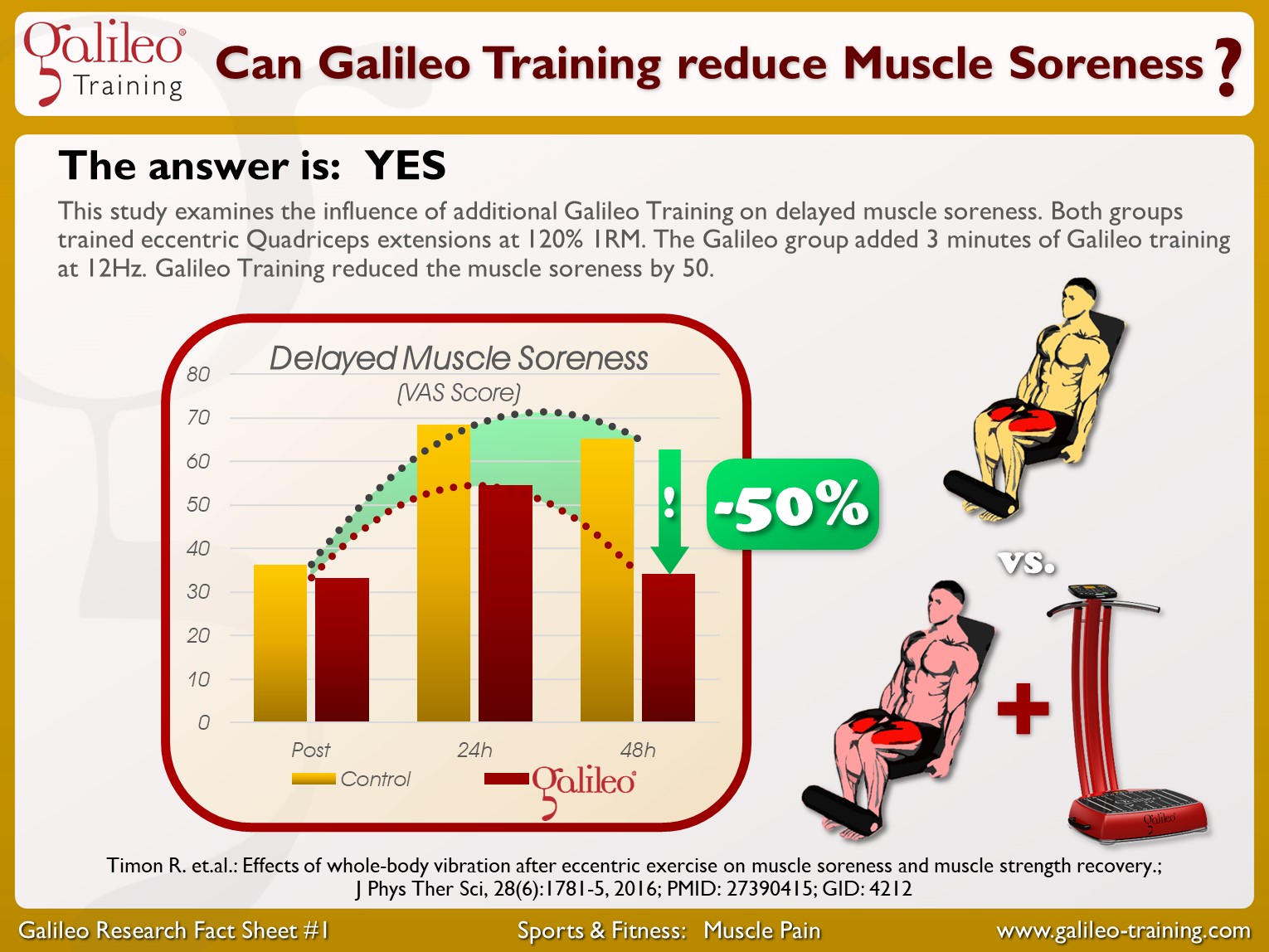
Galileo Research Facts No. 1: Can Galileo Training reduce Muscle Soreness?
This study investigates the influence of Galileo Training on muscle soreness. Both groups trained eccentric quadriceps extension at 120% 1RM. The Galileo group then trained for 3 minutes with Galileo at 12Hz. Galileo Training halved the subjective muscle soreness...